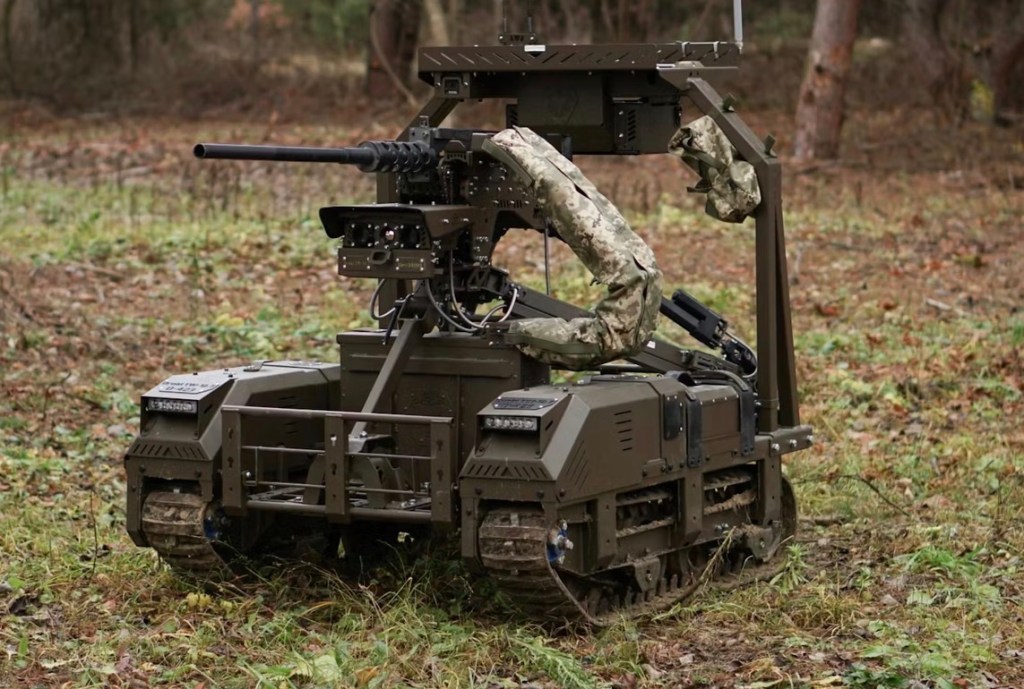
The war between Ukraine and Russia has necessitated, particularly in Ukraine, rapid advancement in weapon technology. Drones, especially, play a vital role in the war, from reconnaissance missions to dropping bombs on the enemy. And progress is still being made: Ukraine has now deployed ground robots onto their frontlines to accompany the machines in the air. But what happens when the frontlines of conflicts become entirely occupied by robots? When human soldiers become obsolete for fighting battles? What will warfare look like and, more importantly, how will wars be won without the incentive for surrender caused by the desire to limit casualties.
Recently, a video was released that shows three bloodied and afraid Russian soldiers emerging from a hideout, hands raised in surrender. But what they are surrendering to is not human, it is a robot soldier. Images of it look quite terrifying: a mini tank with a rotating machine gun attached to its roof. The surreality and horror of encountering such a thing on a battlefield can only be imagined. Its inanimate, non-autonomous appearance is contradicted by its obvious intent to inflict harm on its enemies. It sounds like a scene out of Star Wars or Terminator, but this is real life. Robotic warfare has begun. How it will change the nature of warfare and the role of humans in future conflicts is still unclear.
Although the Ukrainian military has been utilising drones, with ever increasing advancement, since the early stages of the war against Russia, the use of a ground robot for combat is a recent development. Rapid technological progress is occurring in Ukraine as they become pioneers of an increasingly artificial, technologically reliant type of warfare. Sergii Kostezh said in the Kyiv post that “Ukraine is redefining warfare”. This became true out of necessity when Ukraine was faced with an enemy that had more manpower and a much higher military budget. But once change has been catalysed, the option of stasis is removed and the advancement of weapon technology must continue exponentially, lest the enemy overtake.
It is in this way that warfare has always changed: each side must improve their weapons or their strategy faster than their opposition to avoid losing the war. In WWI, for example, this is how the use of poison gas became an efficient offensive weapon. It was used initially by the Germans in 1915 before being adopted by the Allies and subsequently honed into chemical warfare via the alternation of improvement from both sides.
In the war in Ukraine, change is happening even faster, with President Zelensky announcing on the 13th April that a group of ground military robots had captured a Russian fortification without a “single Ukrainian soldier in sight”. At first glance this sounds like a positive development for humans in war: surely, the human cost of war should decrease if combat operations can be carried out by machines rather than human soldiers. However, I think a more thoughtful analysis is necessary because it would not follow historical precedent if advancements made to weapons during war time were to improve the human experience of war or decrease casualties.
World War II, the last major war in Europe and a war that pioneered significant advancement in technology (the most infamous, of course, being the atomic bomb), was the most fatal conflict in human history with a large proportion of casualties being civilians. This does not necessarily indicate that technological advancement makes war more deadly for civilians; the destructiveness of WWII was due in large part to the totalitarian ideologies plaguing Europe in the first half of the 20th century. I think it does, however, demonstrate that the groups most damaged by war, and the methods by which harm is caused to another country, is changing. Total war originated in the 20th century, in large part due to advancements in weapon technology, and in the 21st century this method of warfare can only progress.
This is being demonstrated by the strategies used by both Ukraine and Russia of targeting vital infrastructure such as oil refineries or energy infrastructures. On the 30th April Ukrainian drones hit an oil refinery in the Russian city of Perm, causing a chemical emergency alert in some areas of the city and images of huge clouds of black smoke to appear on social media. These kinds of operations, combined with the Russian targeting of apartment buildings in Ukrainian cities, show that inflicting harm on the wider population, not just the military, is becoming a more and more important strategy for winning a war. When frontlines are being fought by robots, as is becoming the case, countries will have to find other ways to harm their opposition. This could involve an increase in the targeting of civilians and infrastructure vital for the survival of those civilians.
A more explicitly ethical consideration in regard to the human experience of war in a time of exponential technological advancement is also necessary. As warfare becomes increasingly artificial and technologically reliant, direct human action is removed, and with it comes the removal of the moral limitations towards inflicting suffering on another being. Having more destructive, more self-sufficient, weapons makes it easier to commit atrocities. This eventuality was foreseen after WWII when the prosecution of Nazis in Nuremberg and the establishment of international law was treated with immense significance. Again, it was acknowledged by Hannah Arendt when she talked about Adolf Eichmann’s banal form of evil. Banal because he was able to retain an indifferent, impersonal attitude towards the suffering caused by his actions. In a world of rapid technological progress, bureaucratic checks and balances become more important than ever. We can no longer rely on a sense of morality as a restraint of evil when advancements in technology make it effortless to act with no thought of consequences.
It is of great concern that the US, one of the leading advocates after WWII for a new world order maintained by international law, has provided an ideal example of this thoughtlessness resulting from technological advancement. The decision to strike Shajareh Tayyebeh girls’ school in Iran on the 28th February by a US Tomahawk missile was made by AI targeting technology. This technology is being used because of its fast decision making (although one would have thought decisions made in war should be considered rather than impulsive) but, as this morally expensive mistake demonstrates, it cannot be relied upon for its accuracy. Using AI for targeting missile strikes means that, not only do humans not have to witness the suffering caused by their actions, they do not even have to make the decision that will inflict that suffering.
Technological advancement is resulting in wars increasingly being fought by machines, whether they are physically on the frontline or in a computer system operating the release of missiles. The implications of this for the human experience of war are quite terrifying. Machines do not have the restraint provided by a sense of morality and nor, evidently, do humans when they are removed from the suffering inflicted by their actions.


Leave a Reply