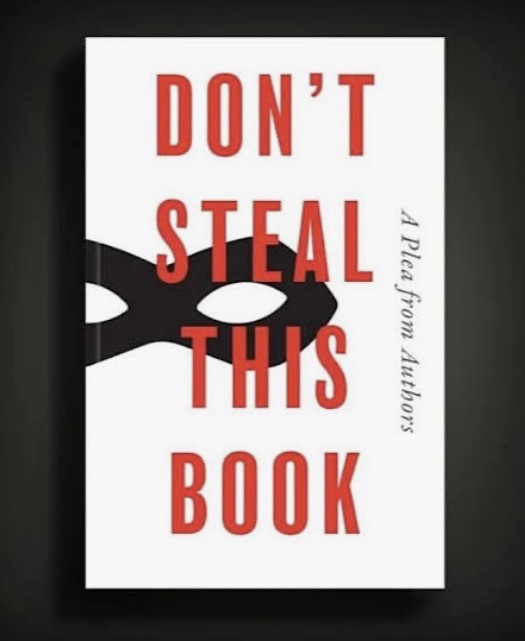
‘Don’t steal this book’ is an ‘empty’ book published in protest against the use of creative works to train AI models without permission from their authors. The names of almost 10,000 authors are included, notably Kazuo Ishiguro and Malorie Blackman, in support of the protest. Although the book has no literal content, it is ‘empty’ only in appearance; its existence is representative of an ongoing, worldwide conflict between creative industries and AI companies. This conflict can be broken down into two categories: one short term, and the main motivation for the publication of the empty polemic, and the other the less visible, but perhaps more sinister, issue of the growing intrusion of AI in the creative industry.
The first point of contention, and the incentive for the book’s publication, are copyright laws that are insufficient in protecting an author’s work being used by AI companies without permission. This came in response to a government proposal to make permission for the use of creative work to train AI models “a broad exception with opt-out”. This would give license for AI companies to use any authors’ work without obtaining their individual permission unless they had explicitly removed consent. Many authors responded with outrage at this proposal, as evidenced by ‘Don’t steal this book’. Their primary concerns were both economic and ethical: the proposal would mean AI companies would not have to pay for the use of authors’ work, and AI trained with the creative work of humans would inevitably make it a stronger competitor in the creative industry.
Since the book’s publication at the beginning of March, a further government report on Copyright and Artificial Intelligence has been released that states a withdrawal of support from the “broad exception with opt-out” proposal. This reversal is almost certainly due, at least partly, to the passionate protest from the creative industry. Fortunately, our government is still able to, at least in this issue, prioritise unchallenged human involvement in the creative industry over technological advance. How long their defense of creatives will last, however, particularly with insistence from AI companies in the necessity of high quality work to improve their AI models, is uncertain. There are many moments of ambivalence in the new report in which a desire to protect the creative industry from the intrusion of technology is accompanied with an interest in “the extraordinary potential of AI to grow the economy and improve lives”.
Although the government seems to be making an effort to protect authors and their work, the fact that the copyright issue in regard to AI existed indicates that technological progress is faster than legal bureaucracy can keep up with. The implications of this disproportionate rate of change will almost certainly create further difficulties in the future. These difficulties won’t be limited to the creative industry, however, the conflict between creativity and technology can only be exacerbated as the rate of technological improvement increases.
The second, more sinister, issue alluded to by ‘Don’t steal this book’ is the growing intrusion of AI in the creative industry and what this intrusion might mean for the future of human creativity. A concern voiced by some of the authors who included their names in the protest was that the use of novels to train AI would allow it to appear more human. Not only could this make AI a competitor in the creative industry, it could make human writers redundant. AI is both faster and cheaper than humans. The empty pages of ‘Don’t steal this book’ are symbolic of this existential threat: authors will be left with no work if AI takes over creation.
Moreover, the threat of AI creation will necessitate a drastic re-defining of art; currently, works of art are an external expression of human thought and emotion, a physical and visual connection between people. If AI starts creating, the human producer is removed and only the consumer remains. This would make the artwork devoid of its earlier meaning; it’s no longer a communication of human experience, it is an empty aesthetic.
The threat of novel theft by AI companies that is being protested in ‘Don’t steal this book’ is therefore representative of a much wider threat to the creative industry from technology. It represents concern that the human element is being removed from the process of creativity. And, from this, represents a concern that we may have misunderstood, or forgotten, the meaning of art (which includes literature). That “art for art’s sake” is, ultimately, an oxymoron because art cannot be removed from the human experience that gave birth to it. And that, therefore, art made by AI is not really art at all.


Leave a Reply